There is a version of this problem where you know exactly where the data is going, and a version where you do not. If you are moving to QuickBooks Desktop or to current Quicken, those have their own dedicated formats and dedicated conversions. If you are leaving old software and heading somewhere modern without having entirely decided where, OFX is the format worth converting to, because it is the one nearly everything accepts.
Xero imports OFX. Sage 50 and Sage Business Cloud import OFX. MYOB imports OFX. GnuCash and HomeBank import OFX. Zoho Books imports OFX. Wave imports OFX. Converting a QIF archive to OFX turns twenty-year-old records into something you can carry into whichever of those you end up choosing, rather than committing to a destination before you have picked one.
Ledger Tome reads the QIF and writes the OFX, supplying the context QIF never recorded and adding the transaction identifiers that make importing safe. This page covers what a QIF archive holds, what has to be stated because the format never stored it, and what you gain by moving to OFX.
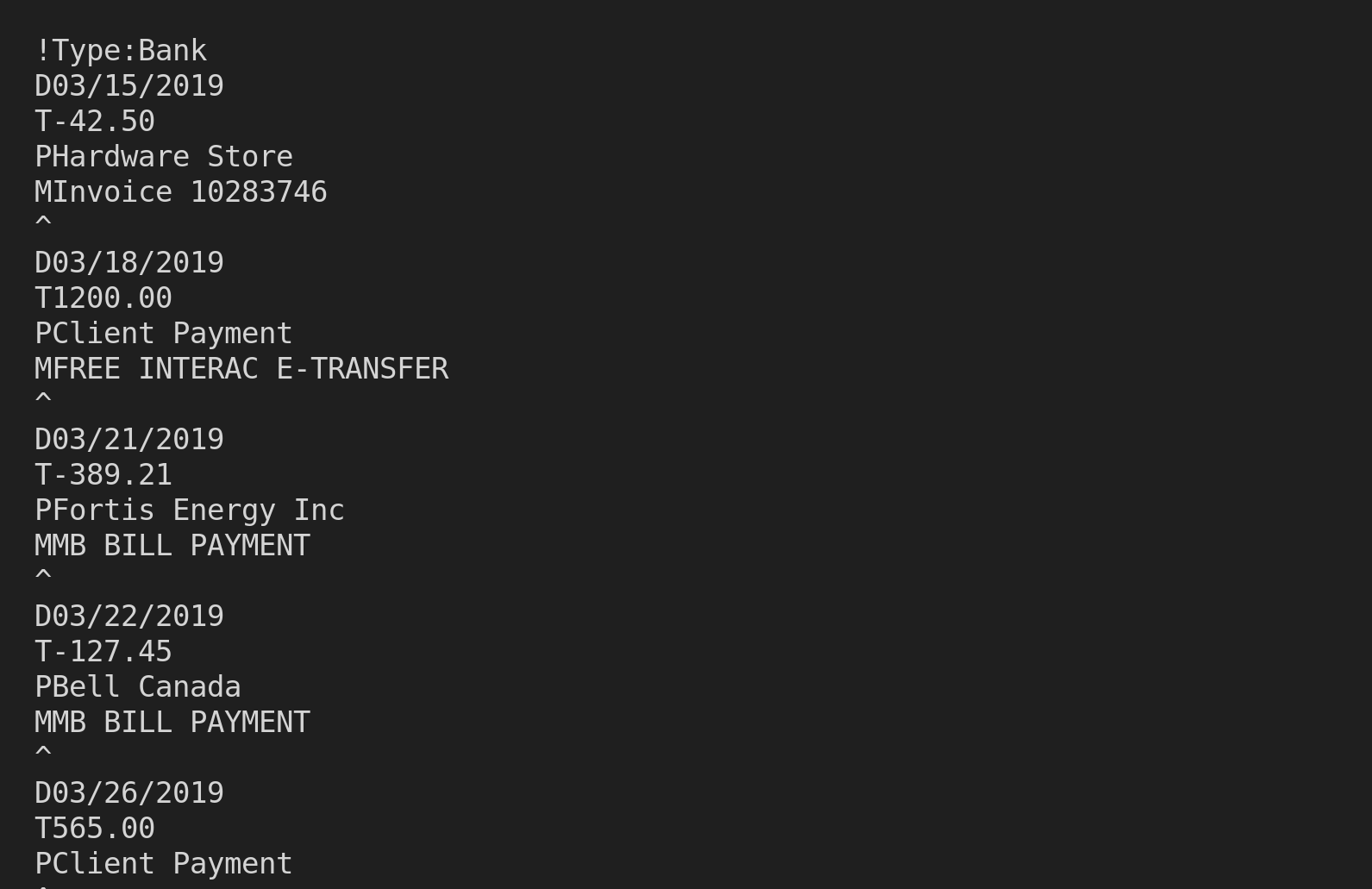
Why a QIF Archive Won't Go Straight Into Modern Software
The records are complete. The format is the obstacle:
Modern software dropped QIF
Xero, Sage, and most cloud accounting tools never supported it. Odoo removed support in 2005. Quicken restricted it years ago.
QIF states no date format
Nothing in the file says whether 03/04 is March or April, so any reader has to be told which.
No currency, no account, no IDs
QIF records transactions and nothing around them, including the identifiers that stop a repeat import duplicating everything.
The original software is gone
Microsoft Money is discontinued and old Quicken versions do not run on current systems, so exporting again is rarely an option.
What is missing is context rather than data, and it only has to be supplied once per file.
What Moving to OFX Actually Gets You
OFX is not just a more widely accepted format. It carries things QIF structurally cannot.
QIF has
- The date, in an unstated layout
- A signed amount
- A payee and a memo
- An account type header
OFX adds
- A unique identifier on every transaction, so re-imports deduplicate
- An encoded date that cannot be read two ways
- The currency and the account, carried in the file
- A statement structure with balances, rather than a bare list
The transaction identifiers are the practical difference and they are worth understanding before you import anything. A QIF file imported twice produces two copies of every transaction, because nothing in it lets the software recognize a repeat. An OFX file imported twice produces nothing the second time. When you are loading years of archive into new software, possibly more than once while you get the setup right, that distinction saves a great deal of cleanup.
Because QIF records no date layout and no currency, you state both once at import. If you know the opening balance for the period, entering it reconstructs a running balance down the file and derives the closing figure, which makes the archive far easier to check against whatever records you still have.
Categories do not travel. Ledger Tome reads dates, amounts, payees, and memos; category and check number lines in the source are not carried into the OFX, and OFX has no standard field for them anyway. Your new software will categorize the imported transactions using its own rules, which is where that logic belongs.
Heading somewhere specific? See QIF to QBO for QuickBooks Desktop and QIF to QFX for current Quicken. Want to read the archive first? See QIF to CSV .
Common Ways to Get a QIF Archive Into Modern Software
Import the QIF Directly
Worth checking whether your destination accepts QIF at all. GnuCash and MYOB do; most cloud accounting software does not.
Install the Old Software First
Finding era-appropriate software and a machine that runs it, to export something more modern. Occasionally successful, rarely quick.
Retype the History
Guaranteed to work and guaranteed to take days for a real archive.
Automated QIF to OFX Conversion
Reads the archive directly and writes an OFX with proper dates, currency, and transaction identifiers. Free to start.
QIF to OFX: Method Comparison
| Method | Time Required | Accuracy | Best For | Cost |
|---|---|---|---|---|
| Direct QIF import | Instant, where supported | No duplicate protection | GnuCash, MYOB, older tools | Free |
| Old software chain | Hours to days | Varies | Determined archivists | Old licenses |
| Retyping | Days for a real archive | Human error rate | Very small archives | Your time |
| Ledger Tome | Under a minute | Dates confirmed, duplicate-safe | Any QIF archive | Free to start |
Why automated conversion wins: the archive does not need recreating, only re-wrapping in a format that modern software accepts and that protects you while you import it.
How Ledger Tome Converts QIF to OFX
Ledger Tome parses QIF records natively and writes standard OFX.
Upload
Upload your .qif archive
Record Parsing
Dates, amounts, payees, and memos read from the record structure
Confirm & Review
State the date layout and currency, then check every transaction
Download OFX
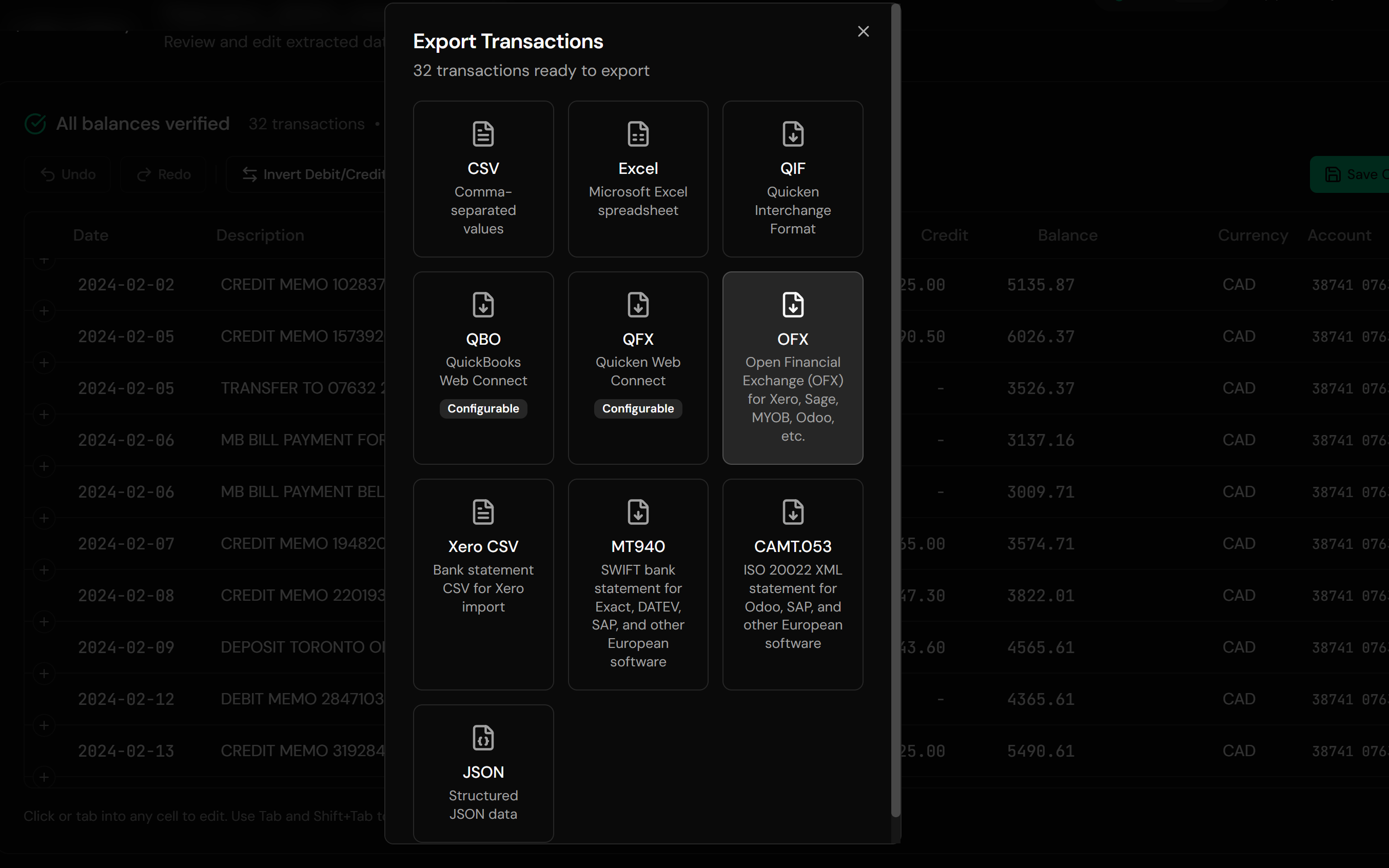
A standard OFX statement file
Payee and memo are joined into complete descriptions. Credit card archives are recognized from the type header and their sign convention handled. Records without a usable date are skipped and counted in a warning rather than being placed at a guessed date. Every transaction in the OFX gets a stable identifier derived from its date and position, so re-importing the same file will not duplicate anything.
From Legacy Archive to a Portable Statement File
Before: Raw QIF
After: Standard OFX
Use Cases for QIF to OFX Conversion
Leaving Legacy Personal Finance Software
Taking the history somewhere modern.
Choosing New Software
Converting to the format most candidates accept, before committing to one.
Personal Records Becoming Business Records
A side income formalized, with its history intact.
Restoring an Old Backup
Files recovered from a machine that no longer exists.
Consolidating Discontinued Tools
Microsoft Money and similar, merged into current software.
Historical Backfill
Loading years of archive into a newly set up book.
Who QIF to OFX Conversion Is For
This type of conversion is commonly used by:
Former Quicken & Money Users
Whose exports outlasted their software.
People Moving to Xero or Sage
Where OFX is the standard import.
MYOB & GnuCash Users
Both accept OFX, and both benefit from its transaction IDs.
Anyone Undecided About Destination
Convert once, import wherever you land.
Accountants Handed an Archive
Client history in a format from another era.
Anyone Holding a .qif File
The data is yours; the format should not decide where it can go.
Related Converters
Ledger Tome supports multiple input and output formats. Choose the one that fits your workflow:
Specifically for QuickBooks Desktop.
Specifically for current Quicken.
Reading the archive in a spreadsheet first.
The other direction, for QIF-only software.
A common destination for the converted file.
What Ledger Tome Does Not Do
For clarity and transparency, Ledger Tome does not:
- Access bank accounts directly
- Initiate or modify transactions
- File taxes or submit reports
- Replace accounting software
- Categorize transactions automatically
It focuses solely on converting statement data into structured, accounting-ready formats.
Security & Privacy
Your Financial Data is Protected
We take statement security seriously. Here's how we protect your data:
-
Encrypted in transit and at rest
TLS on everything moving in or out, AES-256 on anything stored
-
No one reads your statements
Conversion is automated end to end. A person only ever sees a document if you send it in yourself on a conversion that failed
-
Automatic Deletion
All uploaded files are permanently deleted after 7 days (or immediately upon request)
-
No Training Data
Your statements are never used to train AI models or shared with third parties
-
No Account Access
We never access your bank account directly or store your banking credentials
-
GDPR Compliant
Full compliance with data protection regulations
-
No Permanent Storage
We don't maintain a database of your financial information
Privacy First: We process your data solely for conversion purposes. No marketing, no data selling, no third-party sharing.
Frequently Asked Questions
How do I convert a QIF file to OFX?
Which software accepts OFX?
Why does it ask me for the date format?
What do I gain over importing the QIF directly?
Do my categories come across?
My archive is from Microsoft Money. Does that work?
My file has several accounts in it.
Will I get running balances?
Are credit card archives handled?
Some records were skipped.
The files are from the 1990s. Does age matter?
How much does it cost?
Troubleshooting Common Issues
Dates look wrong after import
The layout chosen at import did not match how the archive was written. Re-import with the other layout; a transaction you can independently date is the fastest way to tell which is right.
The software rejected the OFX
Check the .ofx extension survived the download and that the currency matches the account you are importing into.
Transactions went to the wrong account
Confirm the target account during your software's import rather than letting it default.
Fewer transactions than expected
Check the skipped-record warning. Records without a parseable date are excluded rather than guessed at.
Amounts have the wrong sign
Check whether the archive is a credit card file. The preview shows the interpreted sign per transaction and anything can be corrected there.
Summary
QIF archives hold complete history in a format modern accounting software has almost universally dropped, and converting to OFX is the move that keeps your options open: it is the format Xero, Sage, MYOB, GnuCash, Zoho Books, and Wave all accept. Beyond compatibility, OFX adds the transaction identifiers that make importing years of archive into new software a safe, repeatable operation rather than a one-shot you cannot undo.
If you have QIF archives that need to reach modern software, Ledger Tome converts them in under a minute.
Ready to Move Your Archive Forward?
Stop leaving years of records in a format nothing modern will read. Convert your first QIF archive to OFX in minutes.
Used by former Quicken and Money users, accountants, and anyone modernizing their books