This conversion runs backwards compared with most, and for a good reason. Your bank has modernized and now offers a "download for Quicken" button that produces a .qfx file. Your software has not modernized, and its import menu offers QIF and nothing else. The file you can get and the file you can use are different files, every single month.
That gap turns up in more places than it should. Quicken versions from 2004 and earlier read QIF rather than QFX. MYOB accepts QIF and OFX. GnuCash and HomeBank both take QIF happily. None of them will look at a Web Connect file. Meanwhile the banks that still offer a QIF download are steadily disappearing, so the older the software, the more likely its owner is stuck in exactly this position.
Ledger Tome reads the QFX and writes the QIF, keeping the transactions intact and letting you set the date layout your program expects. This page covers what changes between the two formats, what QIF cannot carry, and how to make the swap a routine step rather than a monthly obstacle.
Why Your Software Won't Take the File Your Bank Gives You
Two formats from different eras, and the choice is not yours to make:
The bank picked QFX
Web Connect became the standard download, and QIF options have been quietly retired from bank export pages for years.
Your software picked QIF
Older Quicken, MYOB, GnuCash, and a long tail of tools read QIF and do not recognize Web Connect files at all.
QIF states no date format
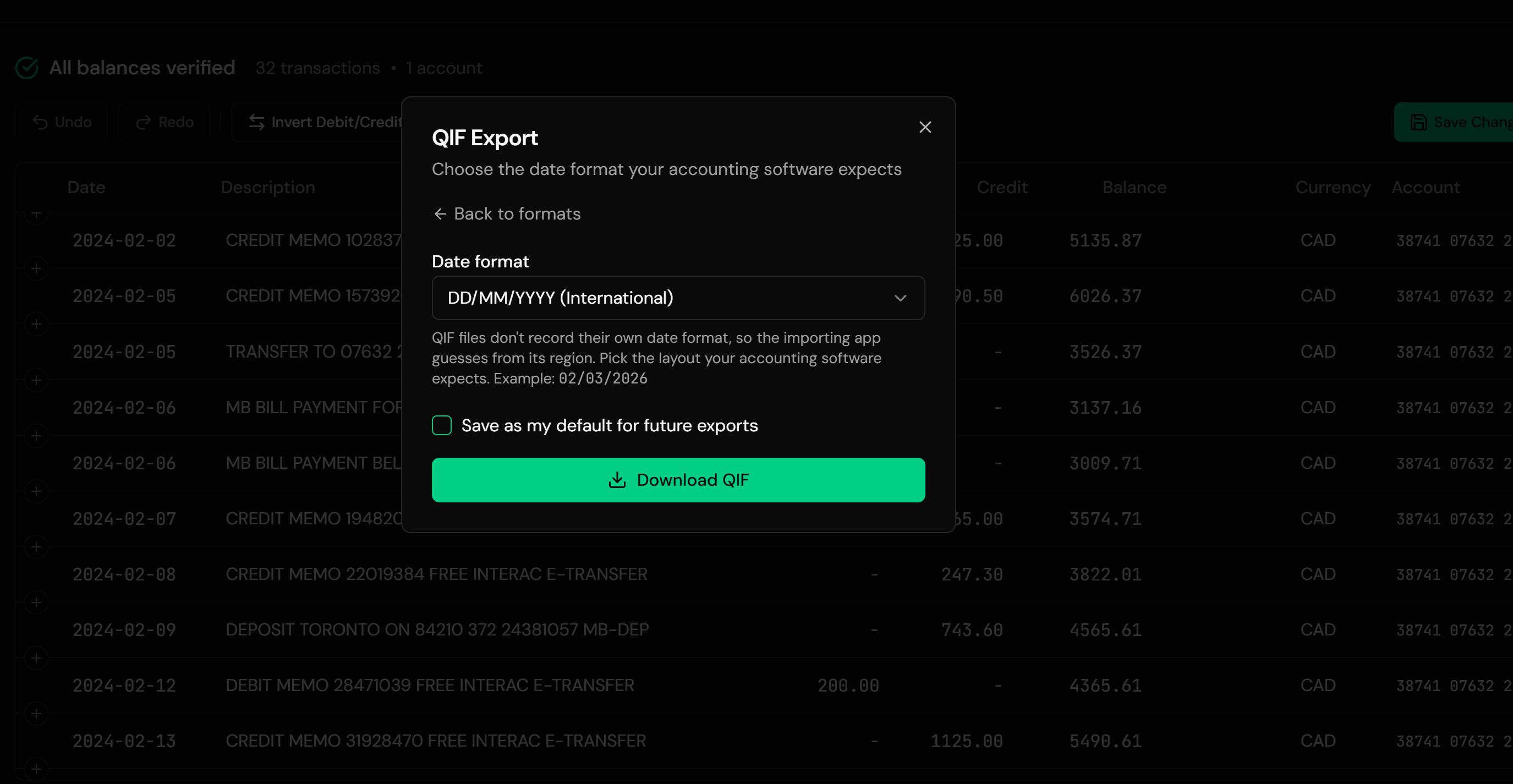
Nothing in a QIF file says whether 03/04 is March or April, so the importing program decides by locale. Get it wrong and every date is wrong.
QIF carries less
No currency, no account number, no transaction IDs. Some of what the QFX holds simply has nowhere to go.
The transactions transfer completely. What needs care is the date layout and knowing which extras do not survive the trip.
QFX and QIF: What Survives the Conversion
QFX is a structured, tagged statement format. QIF is a plain-text record list from an earlier generation. Going from the first to the second is a narrowing, and it helps to know exactly where.
What transfers
- Every transaction's date, amount, and description
- Payee and memo, joined into one complete description
- The account type, including credit card handling
- Running balances, where the source provides them
What doesn't
- Transaction IDs (FITIDs), so QIF imports cannot deduplicate themselves
- Currency, which QIF has no field for
- Bank and account identifiers
- Categories and splits, which Ledger Tome does not write
The practical effect of the missing transaction IDs is that importing the same QIF twice will duplicate the entries, where a QFX import would have skipped them. Import each period once and keep track of what you have loaded. This is a QIF limitation rather than a conversion artifact: no QIF file from any source carries these IDs.
Prefer to keep the modern format where your software allows it? See QFX to CSV for reading the file, or the full Quicken import guide .
Common Ways to Get QFX Data Into QIF-Only Software
Ask the Bank for QIF
Worth one look at the download page. Most banks retired the option years ago, and the ones that kept it are not adding it back.
Retype From the Statement
Reliable and slow. For a monthly recurring task it is the worst possible answer.
Import Into New Quicken, Export QIF
Requires a current Quicken subscription to act as a format bridge for software you already own. Newer versions have also restricted QIF export.
Automated QFX to QIF Conversion
Reads the Web Connect file directly and writes QIF in the date layout you choose. Free to start.
QFX to QIF: Method Comparison
| Method | Time Required | Accuracy | Best For | Cost |
|---|---|---|---|---|
| Bank QIF download | Instant, if offered | Native | The few banks still offering it | Free |
| Retyping | 30-60 minutes per statement | Human error rate | Nothing recurring | Your time |
| Quicken round-trip | 20+ minutes | Depends on version | Existing subscribers | Subscription |
| Ledger Tome | Under a minute | Field-faithful, date layout chosen | Any QFX, OFX, or QBO file | Free to start |
Why automated conversion wins: it is the only option that does not require either the bank or the software to change something neither of them will.
How Ledger Tome Converts QFX to QIF
Ledger Tome parses Web Connect files natively and writes QIF the way older importers expect.
Upload
Upload your .qfx file
Native Parsing
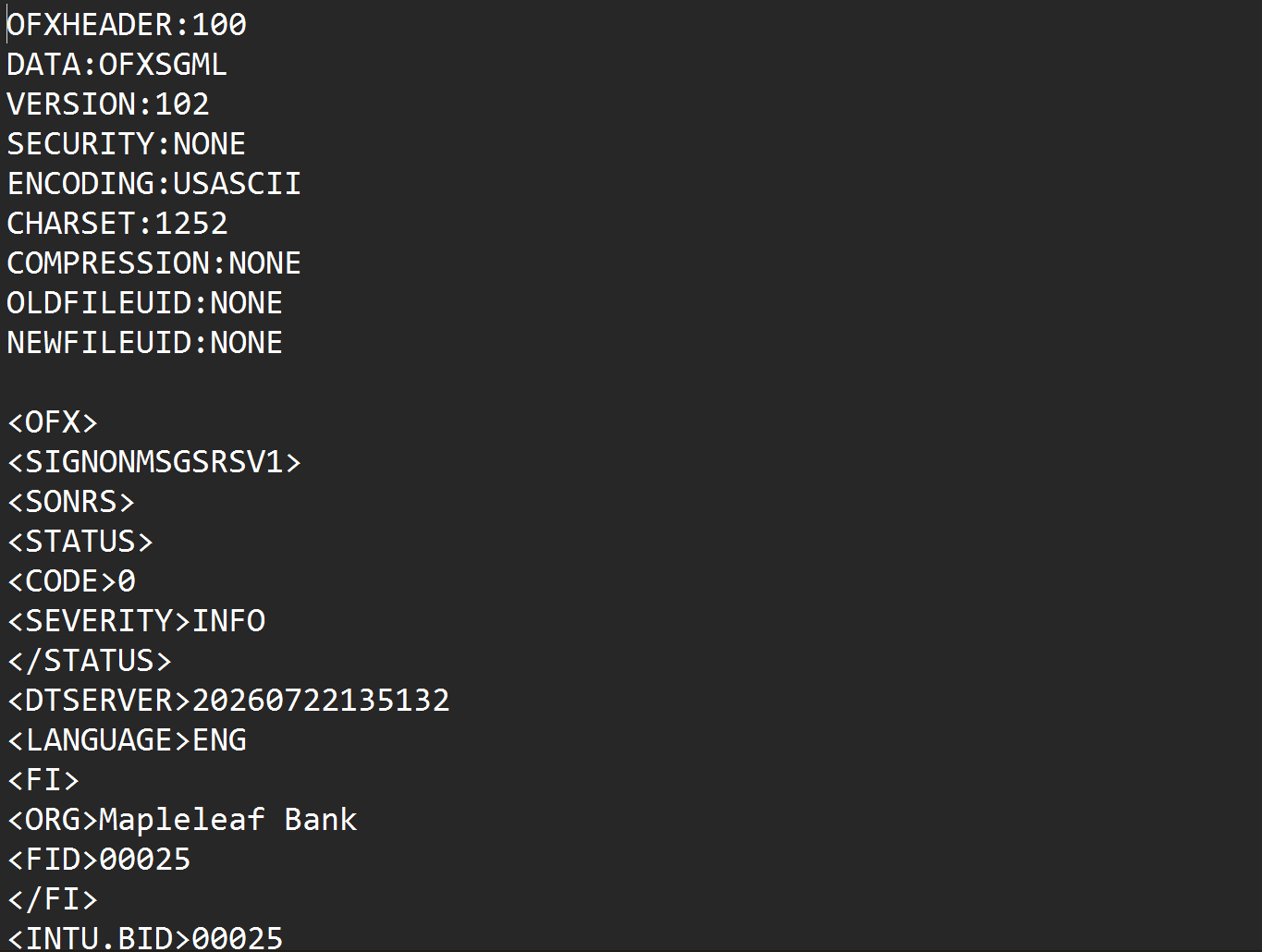
The OFX structure decoded; dates, amounts, and split descriptions normalized
Review & Choose Date Format
Check the transactions and set the layout your software expects
Download QIF
A valid QIF file, one record per transaction
Credit card files are recognized and their sign convention decoded, so charges and payments stay the right way around through the conversion. Payee and memo are joined into complete descriptions before being written to the QIF payee line. Where the source carries a running balance, it is preserved on each record's memo line, which is where QIF readers expect to find it.
From Web Connect to a File Your Software Accepts
Before: raw QFX file
After: QIF ready for import
Use Cases
Older Quicken Versions
Quicken 2004 and earlier read QIF, and the bank stopped offering it.
MYOB Bank Imports
MYOB takes QIF and OFX, never Web Connect files.
GnuCash & HomeBank
Free-software finance tools with dependable QIF import.
Software You Won't Replace
A tool that works, has your history, and is not worth abandoning over a file format.
Monthly Statement Routine
The same conversion every month, done in under a minute.
Feeding a Legacy Tool
Niche and in-house software where QIF was the interchange format of choice.
Who It's For
Long-Time Quicken Users
On a version that still works and still reads QIF.
MYOB Users
Australian and New Zealand businesses importing statement files.
GnuCash & HomeBank Users
Where QIF is a first-class import path.
People Avoiding a Subscription
Owning software outright and intending to keep it.
Bookkeepers With Mixed Clients
Different clients on different eras of software.
Anyone Whose Bank Dropped QIF
The gap between what you can download and what you can import.
Related Converters
Ledger Tome reads and writes many financial formats. Choose the one that fits your workflow:
The generic OFX version of this page.
Reading Web Connect files in a spreadsheet instead.
The other direction: old archives into modern Quicken.
Starting from a spreadsheet export.
The full Quicken import guide.
What Ledger Tome Does Not Do
For clarity and transparency, Ledger Tome does not:
- Access bank accounts directly
- Initiate or modify transactions
- File taxes or submit reports
- Replace accounting software
- Categorize transactions automatically
It focuses solely on converting statement data into structured, accounting-ready formats.
Security & Privacy
Your Financial Data is Protected
We take statement security seriously. Here's how we protect your data:
-
Encrypted Transmission
All uploads use 256-bit SSL encryption (the same security banks use)
-
Secure Processing
Files are processed in isolated, secure environments with no human access
-
Automatic Deletion
All uploaded files are permanently deleted after 7 days (or immediately upon request)
-
No Training Data
Your statements are never used to train AI models or shared with third parties
-
No Account Access
We never access your bank account directly or store your banking credentials
-
GDPR Compliant
Full compliance with data protection regulations
-
No Permanent Storage
We don't maintain a database of your financial information
Privacy First: We process your data solely for conversion purposes. No marketing, no data selling, no third-party sharing.
Frequently Asked Questions
How do I convert a QFX file to QIF?
Why would I want QIF instead of QFX?
Which date format should I choose?
Will importing the same QIF twice duplicate transactions?
Do categories transfer?
Does it work with .ofx and .qbo files too?
Are credit card statements handled correctly?
What happens to the account number and currency?
Will running balances survive?
Can I edit the data before downloading?
How much does it cost?
Troubleshooting Common Issues
Dates are reversed after import
The layout chosen at export did not match what the program assumed. Re-export with the other layout, or use YYYY-MM-DD where your software accepts it.
The software rejected the QIF
Check that the file kept its .qif extension, and that you are importing into an account of a matching type. Some programs require the QIF account kind and the target account to agree.
Transactions imported twice
QIF carries no transaction IDs, so nothing prevents a repeat import. Remove the duplicated batch in your software and re-import the period once.
Amounts have flipped signs
Bank and credit card files use opposite conventions. The preview shows the interpreted sign per transaction; correct it there before export.
Descriptions are longer than expected
Payee and memo are joined so nothing is lost. Shorten them in the preview if your software truncates long payee lines.
Summary
Banks moved to Web Connect downloads and a great deal of working software stayed on QIF, which leaves a monthly gap that neither side is going to close. Converting the file directly keeps every transaction, handles credit card signs correctly, and lets you state the date layout so the target program does not have to guess.
If your bank gives you QFX and your software wants QIF, Ledger Tome bridges them in under a minute.
Ready to Convert Your QFX Files?
Stop choosing between the file your bank offers and the file your software accepts. Convert your first QFX to QIF in minutes.
Used by Quicken, MYOB, GnuCash, and HomeBank users