Quicken users know the pattern: one day the bank download just stops. Direct Connect retired, Express Web Connect erroring, or a new bank that never supported Quicken at all. The account still produces statements and CSV exports; Quicken just can't read them. Ledger Tome converts those files into the format your Quicken version actually imports.
Which format that is depends on your version. Quicken Classic on Windows and Mac imports bank transactions through Web Connect .QFX files. Older versions (2004 and earlier) and several Quicken alternatives use QIF instead. Ledger Tome exports both, from any PDF statement, CSV, or Excel file.
This page maps the options by version, walks through both imports step by step, and covers the quirks (bank identifiers, duplicate handling, date conventions) that decide whether an import lands cleanly.
Why Getting Data Into Quicken Keeps Getting Harder
Quicken's import path is narrow, and banks keep narrowing their side of it:
Banks keep dropping Quicken support
Direct Connect and QFX downloads cost banks money, and the list of supporting institutions shrinks every year.
No CSV import for bank accounts
Quicken Classic has no built-in CSV import for bank transactions. The export every bank offers is the one Quicken won't take.
Generic OFX gets rejected
QFX is Intuit's branded OFX variant with a bank identifier Quicken validates. Renaming .ofx to .qfx almost never works.
PDF statements: unreadable
For older periods, PDF statements are often all that exists, and Quicken can't touch them.
The data exists. It just needs re-packaging into the one file type your Quicken version imports.
QFX or QIF: Which File Does Your Quicken Need?
QFX (Quicken Classic, Windows and Mac)
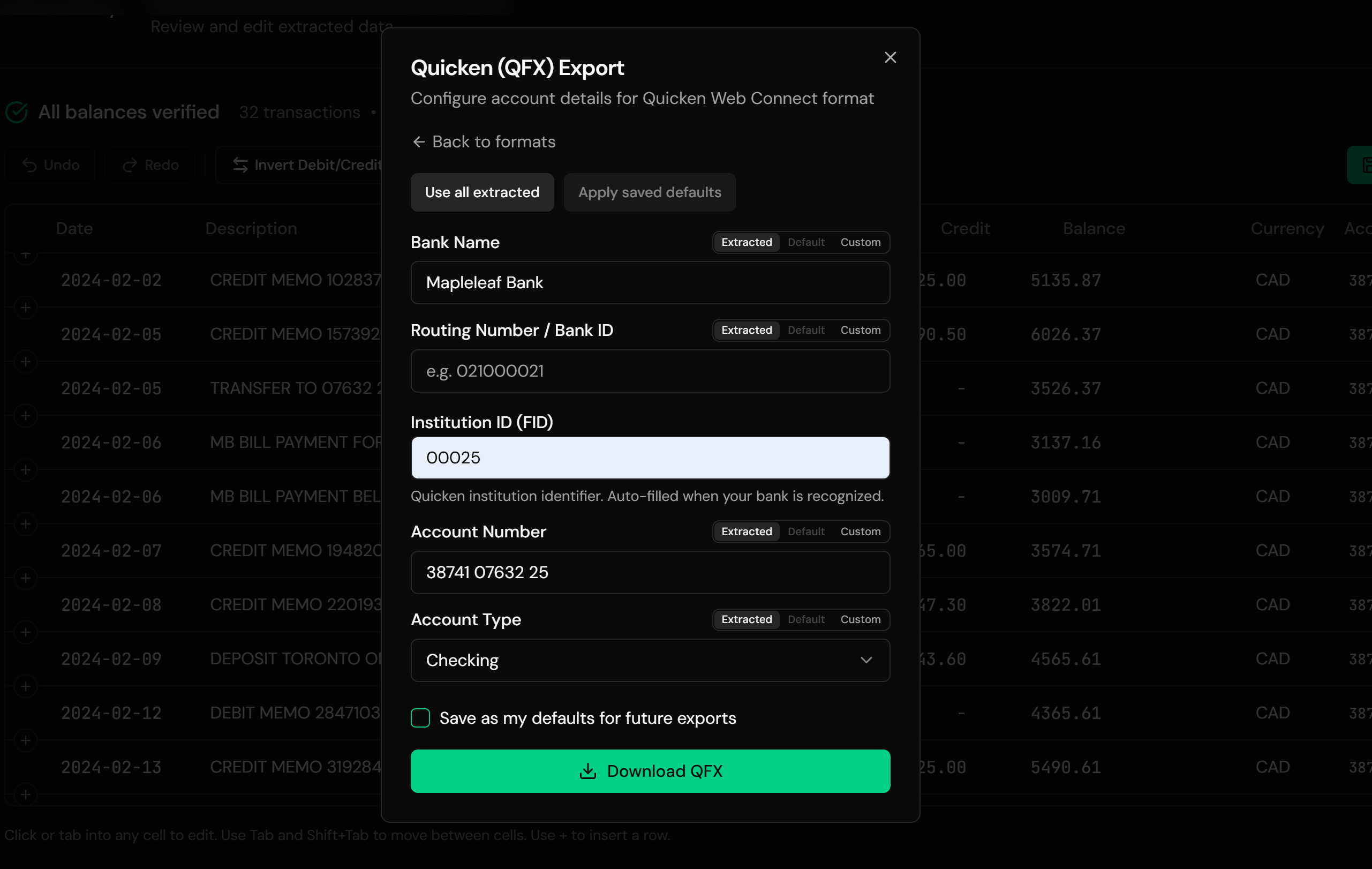
The Web Connect format: OFX-based, carrying an Intuit bank identifier (INTU.BID) and a unique ID per transaction. This is what current Quicken imports for bank and credit card accounts. Ledger Tome resolves the bank identifier from your bank's name, with a manual override at export.
QIF (Quicken 2004 and older, plus alternatives)
The classic interchange format, still read by older Quicken releases, GnuCash, Moneydance, and other tools. No bank identifier involved, but dates are ambiguous by design; Ledger Tome lets you pick the date convention your software expects.
Format deep dives: see CSV to QFX , PDF to QFX , and PDF to QIF .
Works With Statements From Any Bank
Ledger Tome reads PDF statements and CSV/Excel exports from:
US Banks
Chase, Bank of America, Wells Fargo, Citibank, Capital One, US Bank, PNC Bank, Truist, Ally, Discover
Credit Unions & Regional Banks
Often the first to drop Quicken connectivity; any layout works, no templates needed
Credit Cards
Card issuer statements and CSVs convert with correct debit and credit handling
Different layout? The converter detects your file's structure automatically.
How to Import the File Into Quicken, Step by Step
Quicken Classic with a QFX file:
- In Quicken for Windows, go to File > Import > Web Connect File (on Mac: File > Import > Bank or Brokerage File)
- Select the .qfx file you downloaded from Ledger Tome
- Choose the Quicken account the transactions belong to (first import asks; later imports remember)
- Review the imported transactions in your register
Older Quicken (2004 and earlier) with a QIF file:
- Go to File > Import > QIF File
- Select the .qif file and the destination account
- Review the imported transactions
Import chronologically when catching up multiple periods, and give each account its own file. With QFX, re-importing an overlapping file is safe: Quicken skips transactions it has already seen by their IDs.
How Ledger Tome Prepares Your Statements for Quicken
Ledger Tome is an AI-powered tool that turns bank statements in any format into valid QFX and QIF files.
Upload
Upload your PDF statement, CSV, or Excel export
AI Extraction
Statement structure, columns, dates, and debit/credit logic detected automatically
Review & Edit
Check every transaction in an interactive preview before export
Download QFX or QIF
Pick the format your Quicken version imports
QFX output carries your bank's Intuit identifier (editable at export) and a unique FITID per transaction, so re-imports never duplicate your register.
From Bank Statement to Quicken Register
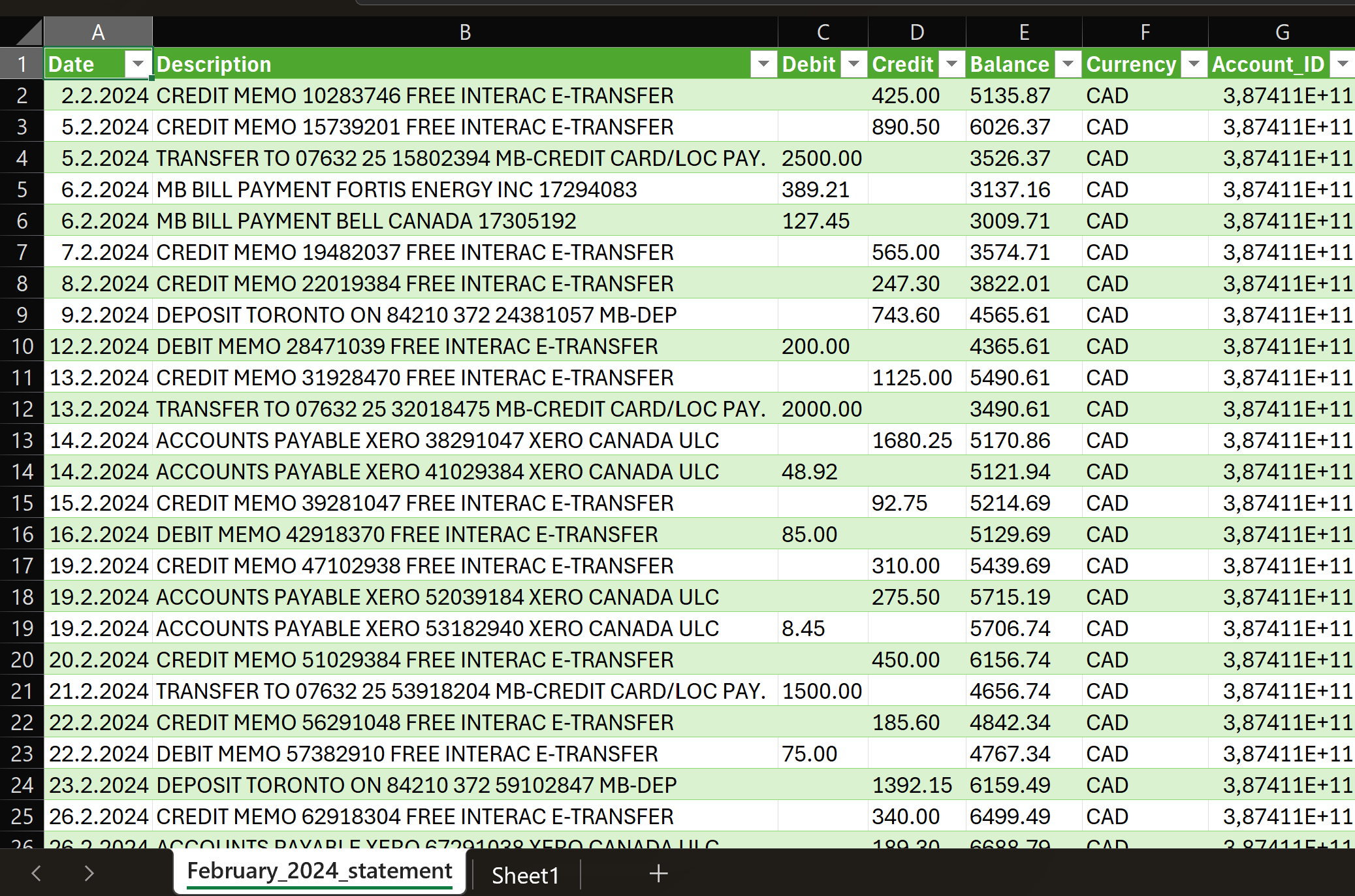
Before: statement file
After: Quicken-ready QFX
Use Cases
Your Bank Dropped Quicken Downloads
The most common trigger. Convert the bank's CSV or PDF and keep the same import routine.
Credit Union Accounts
Institutions that never offered Quicken connectivity in the first place.
Filling Download Gaps
Reconnect after an outage and import the missing weeks from a statement.
Historical Records
Load years of past statements beyond any download window.
Credit Card Accounts
Card statements convert with correct signs, so charges and payments land the right way.
Maintaining Long-Running Files
Decades-old Quicken files deserve complete data, whatever the bank does.
Who It's For
Quicken Classic Users
Deluxe, Premier, and Home & Business on Windows or Mac.
Long-Time Quicken Holdouts
Users on older versions who need QIF, not QFX.
Users of Banks That Dropped Quicken
Restore imports after Direct Connect or Web Connect retire.
Credit Union Members
Where CSV is the only export on offer.
Bookkeepers for Individuals
Managing personal or household books in Quicken for clients.
Anyone With Years of Quicken History
Switching tools is worse than converting files.
Related Converters
Ledger Tome supports multiple formats and destinations. Choose the one that fits your workflow:
The CSV-first format page for Quicken Classic.
The PDF-first format page for Quicken Classic.
Transactions in a workbook? Convert XLSX straight to a Quicken-ready QFX.
For older Quicken versions, GnuCash, and other QIF readers.
Moved from Quicken to QuickBooks? The Desktop guide.
What Ledger Tome Does Not Do
For clarity and transparency, Ledger Tome does not:
- Access bank accounts directly
- Initiate or modify transactions
- File taxes or submit reports
- Replace accounting software
- Categorize transactions automatically
It focuses solely on converting statement data into structured, accounting-ready formats.
Security & Privacy
Your Financial Data is Protected
We take statement security seriously. Here's how we protect your data:
-
Encrypted Transmission
All uploads use 256-bit SSL encryption (the same security banks use)
-
Secure Processing
Files are processed in isolated, secure environments with no human access
-
Automatic Deletion
All uploaded files are permanently deleted after 7 days (or immediately upon request)
-
No Training Data
Your statements are never used to train AI models or shared with third parties
-
No Account Access
We never access your bank account directly or store your banking credentials
-
GDPR Compliant
Full compliance with data protection regulations
-
No Permanent Storage
We don't maintain a database of your financial information
Privacy First: We process your data solely for conversion purposes. No marketing, no data selling, no third-party sharing.
Frequently Asked Questions
How do I import a bank statement into Quicken?
Can Quicken import CSV files?
Can Quicken read PDF bank statements?
What's the difference between QFX, OFX, and QIF?
My bank stopped offering Quicken downloads. Is this the fix?
Will importing create duplicate transactions?
Does this work with Quicken for Mac?
Does this work for credit cards?
Quicken rejects the file. Why?
What about Simplifi or other Quicken products?
How much does it cost?
Troubleshooting Common Issues
Quicken rejects the QFX on import
Almost always the bank identifier. Enter your institution's FID manually in the export dialog; if the problem persists, contact support.
Transactions went to the wrong account
Quicken links each file to an account on first import. Delete the imported transactions and re-import against the correct account.
Dates look wrong (QIF)
QIF dates are ambiguous by design. Re-export with the date convention your Quicken version expects; Ledger Tome lets you choose it.
Amounts have flipped signs
Confirm the account type at export (bank vs credit card) and check the sign convention in the preview.
Old Quicken won't open QFX
Versions from 2004 and earlier import QIF, not QFX. Export QIF from the same preview instead.
Summary
Quicken imports bank data through Web Connect QFX files (or QIF for older versions), and banks keep retiring the downloads that used to provide them. CSV and PDF exports carry the same data in packages Quicken can't read, and renaming files doesn't beat the bank identifier check. Converting the statement properly restores the workflow for any bank, any account, any period.
If you have statements waiting to get into Quicken, Ledger Tome converts them in under a minute each.
Ready to Get Your Statements Into Quicken?
Stop retyping transactions into the register. Convert your first statement to QFX or QIF in minutes.
Used by Quicken users, credit union members, and personal finance enthusiasts