Your bank's export page offered OFX, you downloaded it, and double-clicking got you either a wall of tags or a "how do you want to open this file?" prompt. OFX is a data interchange format built for accounting software, not for people. Our converter reads the file and gives you a clean spreadsheet: one row per transaction with dates, payees, and amounts in columns, as CSV or Excel.
OFX comes in two generations, and both are common: the older SGML style with unclosed tags that confuses even XML tools, and the newer XML style. Ledger Tome parses both, along with the Intuit variants of the same format (.qbo and .qfx files), so whatever flavor your bank produced converts the same way.
This page explains what's inside an OFX file, why spreadsheet programs can't open it directly, and how to get analysis-ready data out of it.
Why You Can't Just Open an OFX File
OFX was designed for software-to-software exchange. Everything about it resists casual reading:
Tags instead of columns
Each transaction is a block of tags: TRNTYPE, DTPOSTED, TRNAMT, NAME. Readable in fragments, useless for analysis.
Two dialects, both awkward
OFX 1.x is SGML with unclosed tags that break XML parsers; OFX 2.x is XML that Excel still won't turn into a transaction table.
Compact date and amount encodings
Dates arrive as YYYYMMDD stamps with optional time and timezone suffixes; amounts carry signs whose meaning differs for bank and credit card statements.
Descriptions split across fields
Payee names and memos live in separate tags, often with one truncated. A good conversion joins them back into full descriptions.
The data is complete and structured. It was just never meant for human eyes.
What Is an OFX File?
OFX (Open Financial Exchange) is the standard banks and financial software have used to exchange transaction data since 1997.
You typically end up holding one because your bank's export page offers OFX as its structured download, an accounting handoff produced it, or software exported it. The Intuit variants carry the same statement inside: .qbo (QuickBooks Web Connect) and .qfx (Quicken Web Connect) files are OFX with extra identification tags, and Ledger Tome reads all three, plus extensionless downloads.
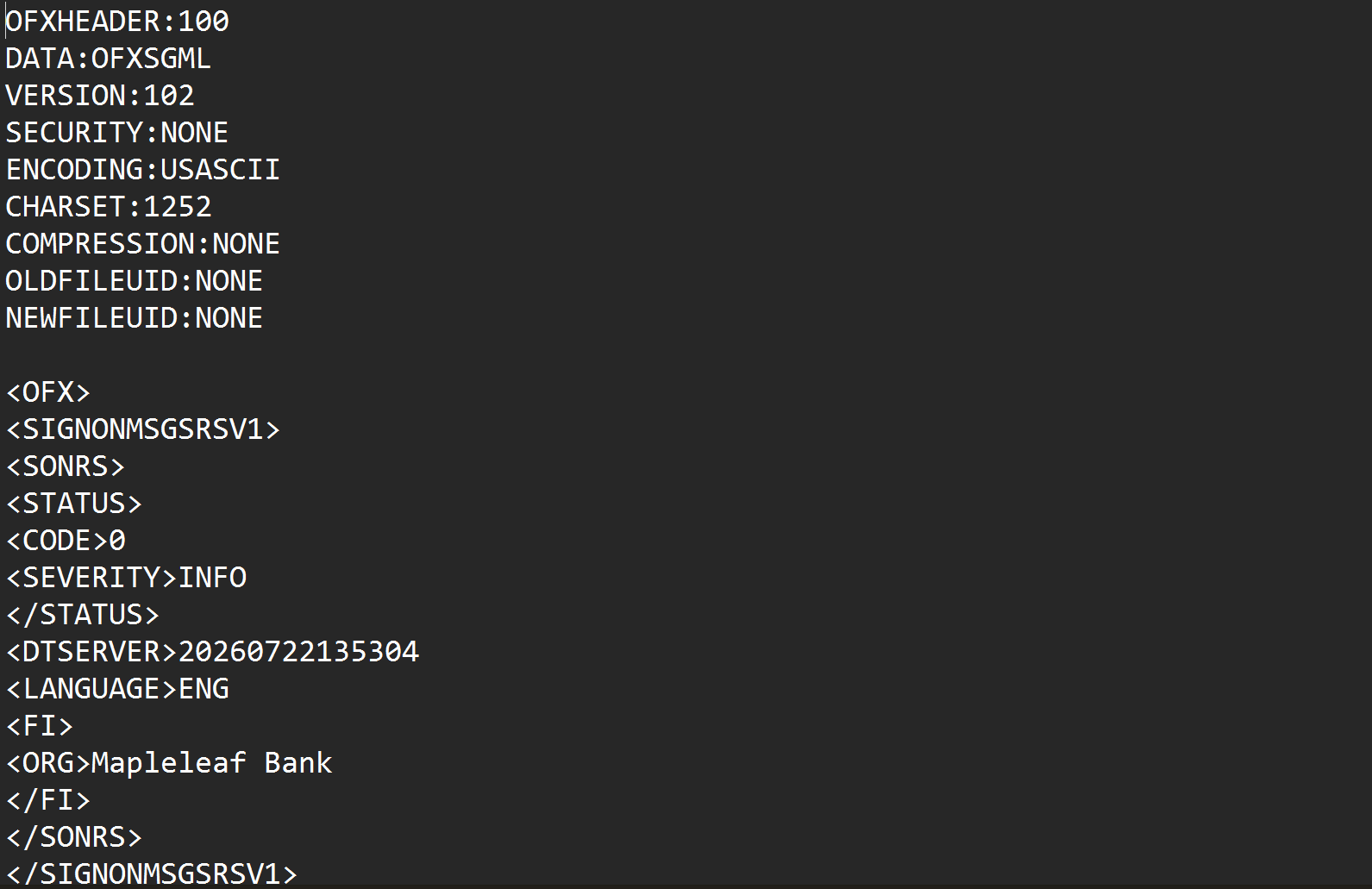
What's inside an OFX file:
OFXHEADER:100
DATA:OFXSGML
VERSION:102

<OFX>
<BANKMSGSRSV1><STMTTRNRS><STMTRS>
<CURDEF>GBP
<BANKTRANLIST>
<STMTTRN>
<TRNTYPE>DEBIT
<DTPOSTED>20260115
<TRNAMT>-4.50
<FITID>2026011500001
<NAME>Coffee Shop
</STMTTRN>
</BANKTRANLIST>
Going the other direction, from statements into OFX for accounting software? See our PDF to OFX and CSV to OFX converters.
Common Ways to Read an OFX File
Open It in a Text Editor
Confirms what the file is. Fragments of payees between tags, no analysis possible.
Excel's XML Import
Fails outright on OFX 1.x (not valid XML), and on 2.x produces nested grids that still need untangling into a transaction table.
Import Into Accounting Software, Then Export
A long detour through software you may not have, with the output shaped by that software's ideas, not yours.
Automated OFX Conversion
Parses both OFX dialects natively, joins split descriptions, handles credit card signs, and outputs a clean spreadsheet. Free to start.
OFX to CSV: Method Comparison
| Method | Time Required | Accuracy | Best For | Cost |
|---|---|---|---|---|
| Text editor | Instant | Read-only squinting | Confirming file contents | Free |
| Excel XML import | 30-60 minutes per file | Fails on OFX 1.x | Nothing reliable | Free |
| Software round-trip | Hours, if you have the software | Depends | Existing software users | Varies |
| Ledger Tome | Under a minute | Field-faithful | Any OFX, QBO, or QFX file | Free to start |
Why automated conversion wins: OFX parsing rules are exactly the kind of thing software should know so you don't have to.
How Ledger Tome Converts OFX to CSV
Ledger Tome parses OFX statement files natively and turns them into clean spreadsheets.
Upload
Upload your .ofx, .qbo, or .qfx file
Native Parsing
Both OFX dialects decoded; dates, amounts, and split descriptions normalized
Review & Edit
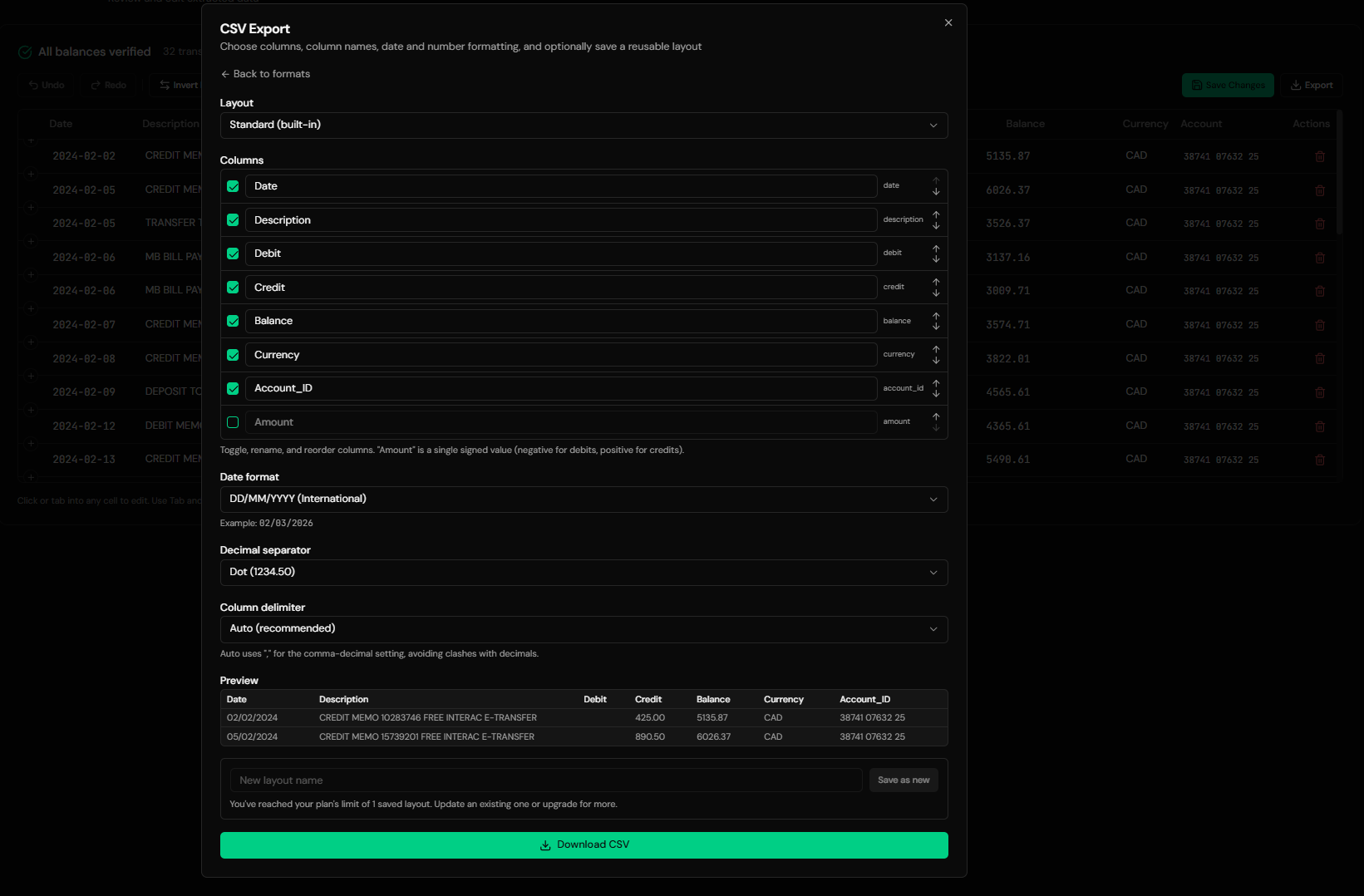
Check every transaction in an interactive preview before export
Download CSV or Excel
One row per transaction, ready for analysis
Credit card statements are recognized and their sign convention handled correctly, so charges and payments come out the right way around. The statement's own ledger balance is preserved as metadata; per-row running balances are not invented, because OFX files don't contain them.
From OFX Tags to a Clean Spreadsheet
Before: raw OFX file
After: clean spreadsheet
Use Cases
Analyzing Your Own Accounts
Filter, pivot, and total transactions your bank only offers as OFX.
Budgeting Workflows
Feed spreadsheet-based budgets from the bank's structured download instead of retyping.
Client Sent a QBO or QFX File
Bookkeepers receiving Web Connect files without the software that opens them.
Leaving an Accounting Tool
Data exported as OFX on the way out, needed as spreadsheets for whatever comes next.
Audit and Workpapers
Independent transaction listings from source files, in a format reviewers can read.
Just Opening the File
Sometimes you only need to see what's in it. That counts too.
Who It's For
Spreadsheet-First People
Budgeters and analysts who live in Excel, not accounting software.
Bookkeepers & Accountants
Reading client bank files without a software round-trip.
Financial Analysts
Getting bank activity into Excel where the actual work happens.
Developers & Consultants
Inspecting OFX deliveries during integrations, without writing a parser.
Switchers
People migrating between finance tools with OFX exports in hand.
Anyone Handed an .ofx File
If you didn't choose the format, you shouldn't need to learn it.
Related Converters
Ledger Tome reads and writes many financial formats. Choose the one that fits your workflow:
The other direction: PDF statements into OFX for accounting imports.
Spreadsheet data into OFX.
Statement arrived as a SWIFT MT940 file instead? Same idea, different format.
PDF statements into Excel.
QuickBooks Web Connect (.qbo) files are the same OFX format with Intuit tags. Read them as spreadsheets too.
What Ledger Tome Does Not Do
For clarity and transparency, Ledger Tome does not:
- Access bank accounts directly
- Initiate or modify transactions
- File taxes or submit reports
- Replace accounting software
- Categorize transactions automatically
It focuses solely on converting statement data into structured, accounting-ready formats.
Security & Privacy
Your Financial Data is Protected
We take statement security seriously. Here's how we protect your data:
-
Encrypted Transmission
All uploads use 256-bit SSL encryption (the same security banks use)
-
Secure Processing
Files are processed in isolated, secure environments with no human access
-
Automatic Deletion
All uploaded files are permanently deleted after 7 days (or immediately upon request)
-
No Training Data
Your statements are never used to train AI models or shared with third parties
-
No Account Access
We never access your bank account directly or store your banking credentials
-
GDPR Compliant
Full compliance with data protection regulations
-
No Permanent Storage
We don't maintain a database of your financial information
Privacy First: We process your data solely for conversion purposes. No marketing, no data selling, no third-party sharing.
Frequently Asked Questions
How do I open an OFX file?
Can I convert OFX to Excel instead of CSV?
Does this work with QBO and QFX files too?
My file is OFX 2.x XML. Does that matter?
What columns does the output contain?
Are credit card files handled correctly?
Will I get running balances?
The payee names look truncated in the raw file. Will descriptions survive?
Can I edit the data before downloading?
Can I convert the OFX into an accounting import format instead?
How much does it cost?
Troubleshooting Common Issues
File isn't recognized
Confirm it's actually OFX: it should contain OFXHEADER or an <OFX> tag near the top. Some banks label other formats as "OFX" loosely.
Some transactions were skipped
Transactions without a posted date can't be placed and are skipped with a warning telling you how many. Check the source file if the count surprises you.
Amounts look reversed
Bank and credit card statements use opposite sign conventions, which the parser decodes from the file type. Check the preview against a known transaction; you can flip anything there before export.
Strange characters in descriptions
The parser preserves what the bank encoded, including escaped characters it un-escapes. What you see is what the file contains.
No balance column in the output
Expected: OFX carries no per-row balances, so none are shown. The statement's closing ledger balance is retained as metadata.
Summary
OFX files carry complete, structured transaction data in a format only software enjoys: two dialects, tagged blocks, encoded dates, and split descriptions. Text editors show fragments and Excel's importers give up or produce grids that need untangling. Automated conversion decodes both dialects natively and delivers what you actually wanted: a clean spreadsheet, one row per transaction.
If you have an OFX, QBO, or QFX file you need to actually read, Ledger Tome converts it in under a minute.
Ready to Read Your OFX File?
Stop squinting at tags. Convert your first OFX file to CSV or Excel in minutes.
Used by budgeters, bookkeepers, analysts, and developers